10月全球航空货运需求增6%,运价同比涨25.9%
Freighter capacity divides air cargo fortunes as rates climb
Xeneta 数据显示,10月全球航空货运需求同比增长6%,运力持平,动态载货率上升2个百分点至63%;全球平均即期运价每公斤3.11美元,环比涨4%、同比涨29%。
Xeneta 与 Baltic 的运价、运力数据按航线和月份拆分,空运卖家可据此核对亚欧与跨太平洋头程报价的走势差异。
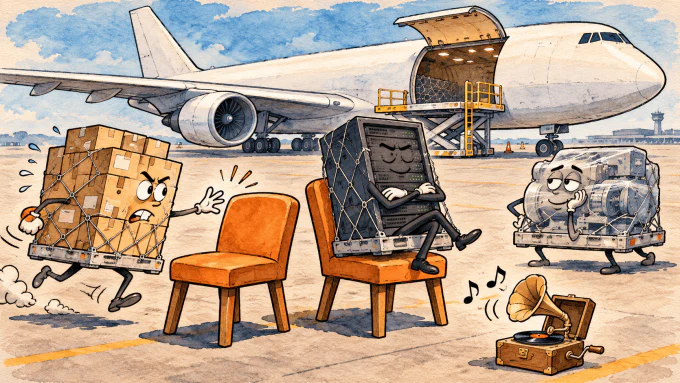
Musical chairs: Competition for suitable freighter capacity is shaping air cargo’s fortunes. AI-generated
By Alex Lennane
6 November 2026
Access – or not – to freighter capacity is helping shape air cargo’s fortunes. IAG Cargo, which shed its freighter operations more than a decade ago, lost traffic following cancelled services, while asset-heavy DHL reported double-digit volume growth.
But rising rates do not necessarily signal a late peak-season surge, according to new analysis from Xeneta.
Global demand increased 6% year on year in October, while capacity remained flat, Xeneta reported today. Its dynamic load factor, of both cargo weight and volume, rose two percentage points, to 63%.
Nevertheless, chief airfreight officer Niall van de Wouw said there were few signs of a sudden increase in capacity pressure or charter prices that would indicate an acceleration in demand.
“The market is continuing its steady pace of growth, as we’ve been reporting since March. It’s strong, but it’s not a ‘peak’ season, and time is quickly running out for volumes to shift higher,” he said.
Strong demand for AI infrastructure is tightening availability on selected routes, while higher fuel costs are pushing up rates even where volumes have weakened.
IAG’s results today illustrate the consequences of losing lift. Third-quarter cargo revenue increased 3.9% year on year, to €294m ($328m), but traffic, measured in cargo tonne km, fell 13.9%, to 1,101m. Revenue per CTK rose 20.7%, more than compensating for the traffic decline.
For the first nine months, cargo revenue declined 5.3%, to €864m, with traffic down 12.8% and revenue per CTK up 8.7%.
“Cargo capacity continued to be impacted by disruption in the Middle East and the cancellation of third-party long-haul freighter capacity, which reduced volumes, particularly from Asia Pacific,” the group said.
Interestingly, IAG Cargo has not issued its own results release. But parent IAG said operating cost savings, fuel-related price increases, and a continued focus on premium and higher-yielding traffic partly offset the impact. Third-quarter performance strengthened through higher yields across India and Asia-Pacific, supported by resilient demand for premium and specialist products.
The group also said it continued to grow its recently launched global cargo joint business with Qatar Airways Cargo and MASkargo. However, its report did not identify the cancelled freighter services or quantify any replacement capacity provided through the partnership.
DHL Global Forwarding, meanwhile, moved 497,000 tonnes of airfreight in Q3, up 12%, or 53,000 tonnes, year on year. The company said growth was particularly strong on Asia-origin tradelanes.
Its Express division provided a more explicit illustration of the value of controlling aircraft capacity. DHL said temporary constraints in the international airfreight market generated additional demand, served through its own global network, contributing approximately €100m to quarterly earnings.
Express operating profit rose 50% to €1.04bn.
Global Forwarding also increased earnings, although the group has not established how much the forwarding volume growth reflected an advantage in securing capacity.
At Emirates, cargo revenue rose sharply even as tonnage edged lower. SkyCargo carried approximately 1.2m tonnes in the six months to September, down 1% year on year, while cargo revenue increased 52%.
Emirates attributed the increase to regional conflict reducing available airfreight capacity, while disruption to shipping encouraged customers to seek air transport. During the period, it added five new 777 freighters and deployed its first passenger-to-freighter converted aircraft, alongside expanding its freighter network and frequencies.
The pricing pressure is evident in the latest Baltic Exchange figures. The Baltic Air Freight Index averaged 2,651.25 in October, up 8.2% from September and 25.9% year on year, according to commentary from Cargo Facts Consulting, published today.
October’s average rate for Hong Kong–Europe increased 11.1% from September, while Shanghai–North America’s BAI82 rose 7.1%.
TAC’s accompanying analysis showed Hong Kong spot rates to the US east coast climbing from HK$51.84 per kg on 30 September to HK$63.02 on 30 October. Rates to Europe rose from HK$35.42 to HK$40.84 over the same period.
Xeneta’s separate dataset put October’s global average spot rate at $3.11 per kg, up 4% month on month and 29% year on year. Europe-North America recorded the largest monthly increase among its 10 selected corridors, rising 10% to $2.31 per kg as airlines moved to winter schedules.
But fuel costs complicate any assumption that higher freight rates translate directly into stronger airline margins. TAC cited IATA figures showing jet fuel prices 112.8% higher year on year on 30 October, alongside strong demand for semiconductors and other AI-related equipment.
Capacity is responding, although the picture varies by corridor and month. Cargo Facts Consulting reported a 5.2% month-on-month recovery in Asia-Europe freighter capacity in September, following three consecutive months of decline. Asia-North America capacity increased 2.3%, its third successive monthly rise.
For October, however, Xeneta reported another decline in direct Asia-Europe freighter capacity, adding to the loss of capacity on routings via the Middle East.
The transpacific market followed a different path. Data shows Asia Pacific-North America chargeable weight around 15% higher year on year last month with freighter capacity growing on a similar trajectory.
In its November market update, CH Robinson said technology shipments were tightening selected Asia-origin services, as oversized and heavy shipments are dependent on freighters.
It warned that airlines could redirect freighters towards stronger transpacific demand, reducing choices elsewhere. However, capacity remained available across most major Asia–Europe services, where the seasonal peak had developed more slowly than anticipated.
Today also brought a move towards closer cooperation between European and Japanese carriers: Lufthansa Cargo and ANA announcing plans to explore reviving their Japan–Europe cargo joint venture, expanded to include Swiss WorldCargo and Nippon Cargo Airlines.
The original venture began in 2014, but was suspended in September 2023 following restructuring within ANA Holdings’ cargo business. A new memorandum of understanding provides a framework for the four carriers to assess cooperation, including additional routing and capacity options.
“We are pleased to renew our dialogue and broaden our cargo joint-venture to include Swiss WorldCargo and Nippon Cargo Airlines,” said Kenichi Wakiya, ANA’s EVP for cargo marketing and services and CEO of ANA Cargo.
The proposed arrangement would combine the carriers’ European and Japanese networks, including NCA’s dedicated freighter operations. No launch date or commitment to additional flights was announced.
Looking further ahead, Xeneta expects rates to decline overall in 2027, and anticipates some Asia-Europe cargo switching back to ocean once shipping schedule reliability shows a sustained recovery, most likely from the second quarter.
“In the past couple of years, it has not been the level of demand that caused the uptick in rates, it has been the availability of capacity. If the Middle East situation recovers, there will be a rebalancing of demand and supply, and rates will then become lower,” said Mr van de Wouw.
But uncertainty continues to complicate longer contracts, he added.
“Forwarders can, of course, offer shippers 12-month deals but, given the market conditions, they would have to bake-in so much uncertainty the price becomes uncompetitive.”
来源:The Loadstar · theloadstar.com