如何在购买前读懂退货托盘清单
How to Read a Return Pallet Manifest Before Buying
读懂退货托盘清单需三步:确认每行具体商品、核对数量与状况描述、把有据可查的事实与转售假设分开,并保留一份未解决事项清单。清单上的零售总额并不等于可售库存、你能实现的价格或利润。Amazon US Liquidation Auctions 条款说明商品按现状出售、配件可能缺失,Liquidation.com 则称退货通常未经检测,除非清单另有说明。
By Zeeshan · Last updated November 3, 2026
Direct answer: Read a return pallet manifest in three passes: identify the exact products, reconcile the quantities and condition descriptions, then separate documented facts from resale assumptions. Keep an unresolved-items list. A listed retail total does not establish working stock, your achievable selling price or profit.
A spreadsheet can make a mixed pallet look unusually precise. It may list a model, a quantity and a retail value on every row while leaving out the fact that decides whether you can sell the item: its actual condition. Start with what the document can support, then make the uncertainty visible before you consider a bid.
If you are still comparing sourcing routes, start with our overview of buying return pallets. This guide focuses on checking the manifest itself, not choosing a supplier.
In this guide
- Which document are you actually reviewing?
- Can you identify the items on each row?
- What does the condition label actually mean?
- How do you reconcile quantities without inventing stock?
- Why is retail value not your likely resale income?
- What should go in the unresolved-items list?
- What belongs in the final pre-bid decision?
- Frequently asked questions
Which document are you actually reviewing?
Save the listing, its lot or order identifier, the manifest file and the condition definitions together. Record when you downloaded them. Distinguish an itemized merchandise list from a shipping document that counts pallets or cartons. Ten pallets is not the same unit of measure as ten products.
Read any stated limits on accuracy, quantities, testing and included accessories. The Amazon US Liquidation Auctions terms describe merchandise sold as is and explain that accessories may be absent. That is a marketplace-specific example, not a description of every supplier or a promise about the lot in front of you.
Can you identify the items on each row?
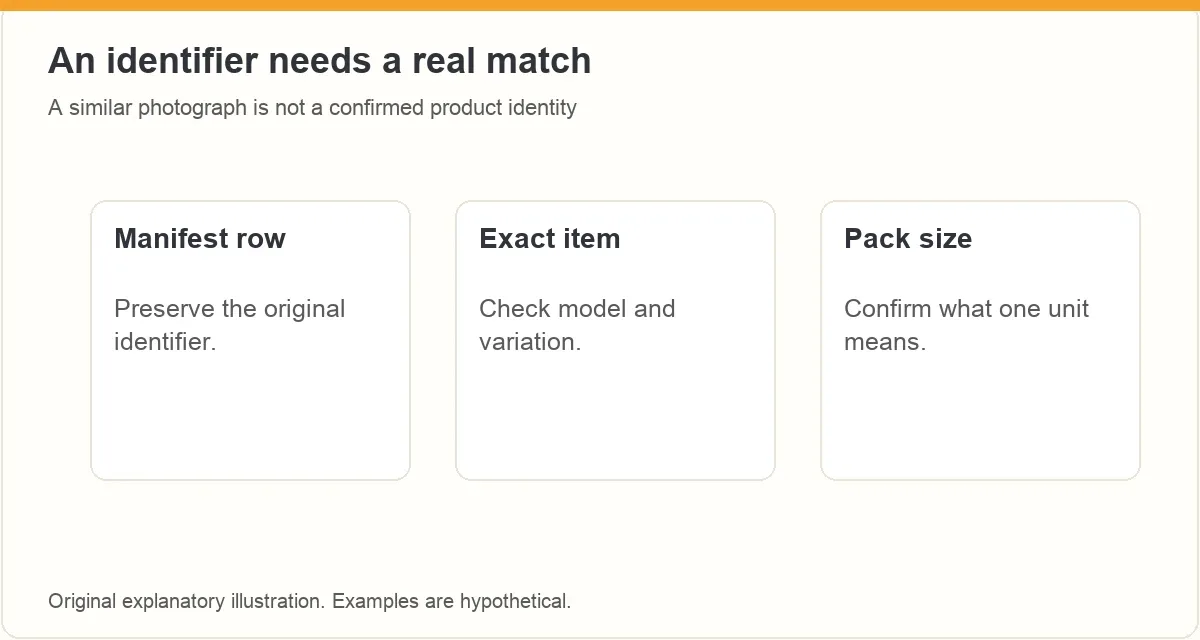
Match brand, model, version, pack size and identifier wherever the listing actually supplies them. Keep the original identifier as text so leading zeroes are not lost. A similar product photograph is a lead for investigation, not a confirmed match. Do not silently substitute a newer model with a higher asking price.
| Manifest field | Check to make | Leave unresolved when |
|---|---|---|
| Product identifier | Match the exact item and variation | The identifier points to several different items |
| Description | Check model, pack size and included parts | A broad category replaces a product identity |
| Quantity | Confirm units versus packs or cartons | The listing does not define the unit |
Keep a notes column beside the original fields instead of editing the supplier file. Your corrected interpretation and the original record should remain distinguishable.

What does the condition label actually mean?
Use the definitions attached to that marketplace and listing. Do not translate returns, mixed, processed or retail ready into new. For example, Liquidation.com explains its condition codes and states that returns are generally not inspected or tested unless the listing says otherwise. Its definitions should not be assumed to apply to another seller.
Record testing claims separately from cosmetic descriptions. A good-looking box does not establish a functioning product, complete accessories or permission to resell it through your intended channel. Flag items requiring a safety, recall, authenticity or selling-eligibility check before treating them as sellable inventory.

How do you reconcile quantities without inventing stock?
Add the listed quantities and compare the result with the listing summary. Count unique product lines separately from units. If a row describes a two-pack, establish whether its quantity counts packs or individual pieces before multiplying it. A missing definition belongs in the unresolved list.
Consider a fictional manifest with four organizer sets, six single trays and two rows both described as a drawer insert. You can total the listed quantities, but you cannot decide that the two insert rows are duplicates without more information. Preserve both rows and ask what distinguishes them. This is an explanatory example, not a supplier record.
Why is retail value not your likely resale income?
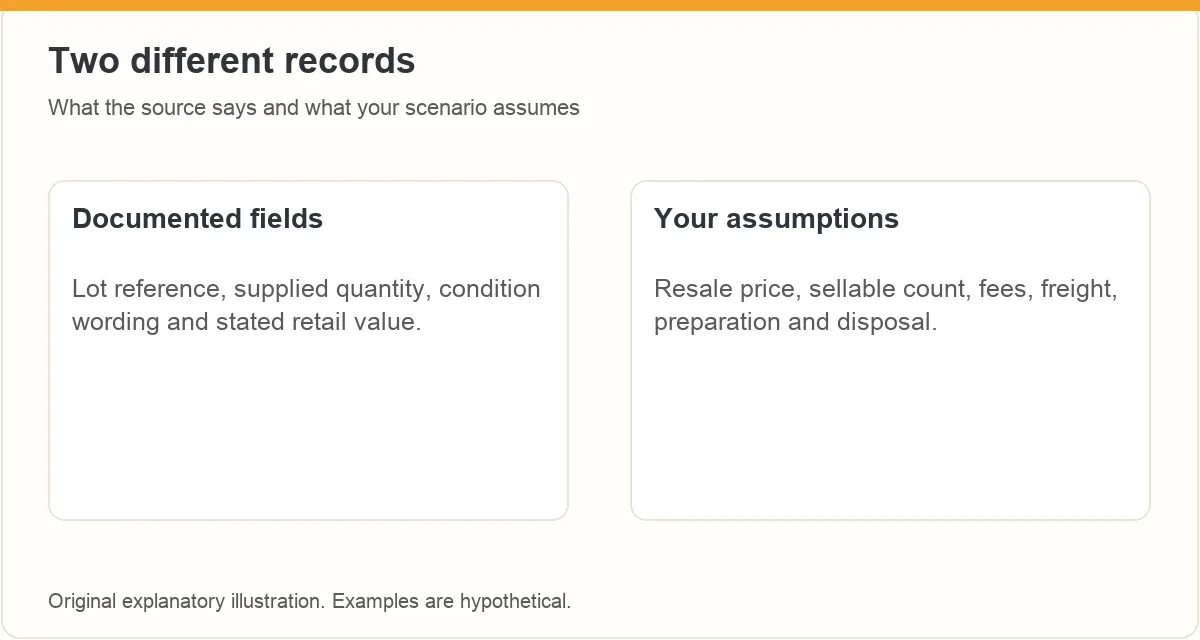
Retail value is a field in the supplied document. Your possible selling price is a separate assumption tied to the exact item, condition and selling channel. Keep sale proceeds separate from platform fees, shipping, preparation, storage, disposal and the cost of stock you cannot sell. None of those costs disappears because the retail total looks large.
Build a conservative scenario with your own evidenced inputs. Show which items have an identified resale route and which remain unpriced or excluded. Do not assign a universal recovery percentage to all customer returns. An attractive forecast cannot repair an unknown model or an untested unit.
What should go in the unresolved-items list?
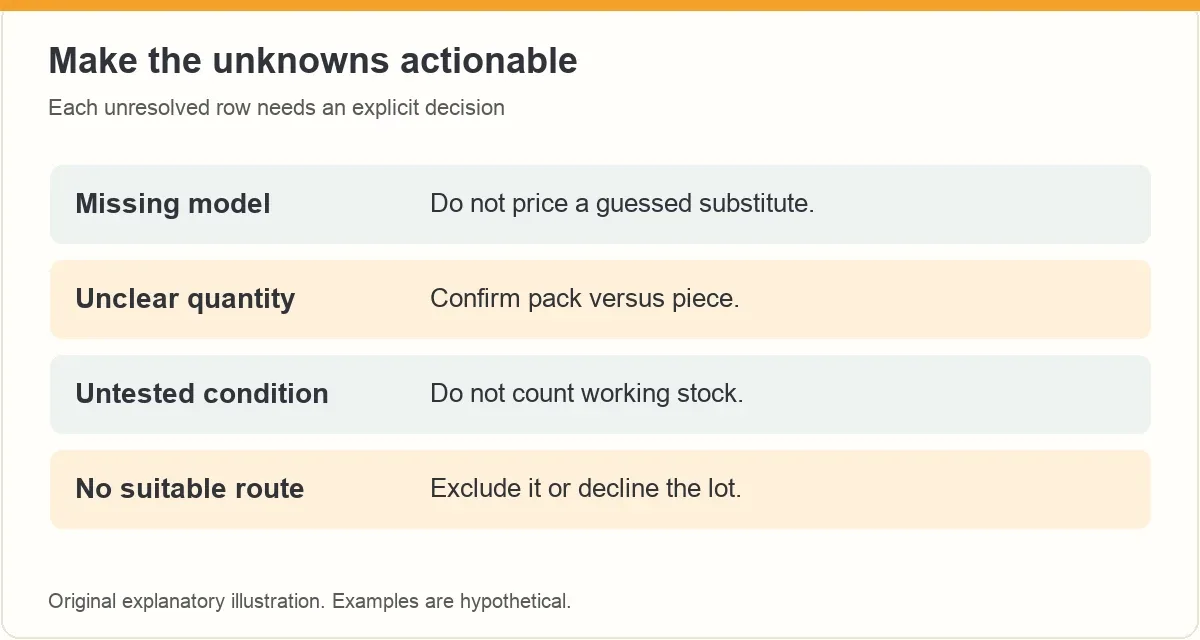
- The exact row and product identifier, not just a category name.
- The missing fact: pack size, test status, accessory, condition or quantity definition.
- The source you checked and the date of that check.
- What you would do if the fact remains unknown: exclude it, seek clarification or decline the lot.
If a decision depends on a promised accessory or test, get that detail in the listing or the seller’s approved written process. Do not rely on a general marketing photograph. Keep deadlines and purchasing terms specific to the actual auction; a spreadsheet review does not change them.
What belongs in the final pre-bid decision?
Write a short decision note that names the lot, the documents reviewed, the largest uncertainties and the assumptions you would need to accept. Keep the bid decision separate from the resale estimate. Declining a lot because its contents cannot be assessed is a valid result of the review.
Before committing, confirm the actual purchase, freight, inspection and reporting terms on the live listing. If your aim is creating videos with products you already own rather than purchasing inventory, ACE training describes a separate creator route; it does not verify pallet condition or supplier claims.
Frequently asked questions
Does a manifest guarantee that every item works?
No. Use the actual listing and testing terms. A product name, quantity or retail value does not by itself establish working condition.
Should I remove repeated rows?
Keep them until you can establish whether they are duplicates, separate quantities or different variations. Preserve the original file.
Can I use the retail total as expected sales?
No. Build a separate scenario using the exact items, condition, achievable prices and costs. Mark unverified inputs clearly.
What if there is no itemized manifest?
Treat the missing detail as uncertainty. Do not invent a product mix or price specific items from a generic pallet photograph.
What should you do next?
A useful manifest review ends with a clear list of what is known and what still determines the decision. Keep that record before comparing research tools or committing money to stock.
ZonBase is an Amazon product research suite with tools for product research, keywords and supplier grading. Its Zon Grading tool takes a list of products by UPC or ASIN, such as a supplier list, and uses your cost to estimate the margin on each item before you commit money to stock.
For more on this, see the SellerAmp vs ZonBase wholesale buying checklist, the best wholesale websites for Amazon sellers and how to set up an Amazon wholesale business.
Research the market before buying stock
Explore ZonBase’s current product research offering, then check whether its scope fits your own research task. Market research does not establish the condition or completeness of liquidation stock.
ZonBase is separate from Amazon. Product research does not verify supplier condition, selling eligibility or future sales.
来源:zonbase · zonbase.com