TikTok Shop 寄样前如何筛选达人
How to Vet TikTok Shop Affiliates Before Sending Samples
TikTok Shop 卖家在寄样前应按近90天GMV、类目匹配度和发帖频率筛选达人,而非粉丝数。Hubfluence 2026年8月的指南称,未筛选达人名单的回片率约12%,配合类目匹配、清晰简报和跟进可超过30%。作者给出六项加权打分表,70分以上寄样、50至69分改为佣金合作、低于50分跳过,三个月未发帖视为休眠。

How do you find good TikTok Shop affiliates?
Vet creators on recent GMV, posting cadence and category fit rather than follower count before sending any sample. Hubfluence puts unvetted post-back rates at about 12% and says tight criteria, a clear brief and follow-up can push them past 30%, which cuts your cost per posted video sharply.
Key takeaways
- Follower count is the weakest predictor of whether a TikTok Shop affiliate will sell your product.
- Unvetted creator lists post back about 12% of the time; vetted lists with a brief and follow-up can pass 30%.
- Treat any creator who has not posted in three months or more as dormant and skip the sample.
- At $18 per sample, moving from a 12% to a 30% post-back rate cuts cost per video from $150 to $60.
- Beyond 20 to 50 creators, filter by niche and 90-day GMV before a human reviews anyone.
On this page
- Why does follower count fail as a filter?
- What should a TikTok Shop creator scorecard include?
- How do you spot a sample farmer?
- What is vetting actually worth?
- Can you vet at scale?
- What we'd do this week
- Frequently asked questions
The best predictor of whether a TikTok Shop affiliate will sell your product is whether they have recently sold products like it, not how many followers they have. Vet every creator on recent GMV, posting cadence and category fit before a sample leaves the warehouse, and you can move from roughly one post in eight samples to about one in three.
Those two figures come from Hubfluence’s August 2026 vetting guide, which puts the typical post-back rate on unvetted creator lists at about 12% and says brands can push past 30% with category fit, a clear brief and follow-up. Our own experience points the same way. Below is the scorecard we use, the red flags that identify sample farmers, and a worked example of what vetting is worth in dollars.
Why does follower count fail as a filter?
Because followers measure attention someone earned in the past, often for content that has nothing to do with selling. Hubfluence calls follower count “the weakest predictor” of results, and notes that nano-creators with recent GMV regularly beat large accounts that have never converted.
Think about what a follower count actually tells you. A creator with 400,000 followers built for comedy skits may have an audience that has never bought anything through a Shop link. A creator with 6,000 followers who reviews kitchen gadgets three times a week, and whose last ten videos all carry product links, has an audience that is used to buying from them. The second creator is the better bet for a kitchen brand, and the sample costs the same.
There is also a newer reason to look past followers. Since June 2026, TikTok Shop scores eligible creators from 0 to 5 on a Promotion Performance Score that is recalculated every 24 hours. Half of it is built from the products a creator promotes and how those products are rated; the other half is content quality. Creators at 4.0 and above start showing a public badge. A badge is not a guarantee of sales, but it is a signal TikTok itself is computing, and it is visible to you. We cover how that score works in our post on Promotion Performance Score.
What should a TikTok Shop creator scorecard include?
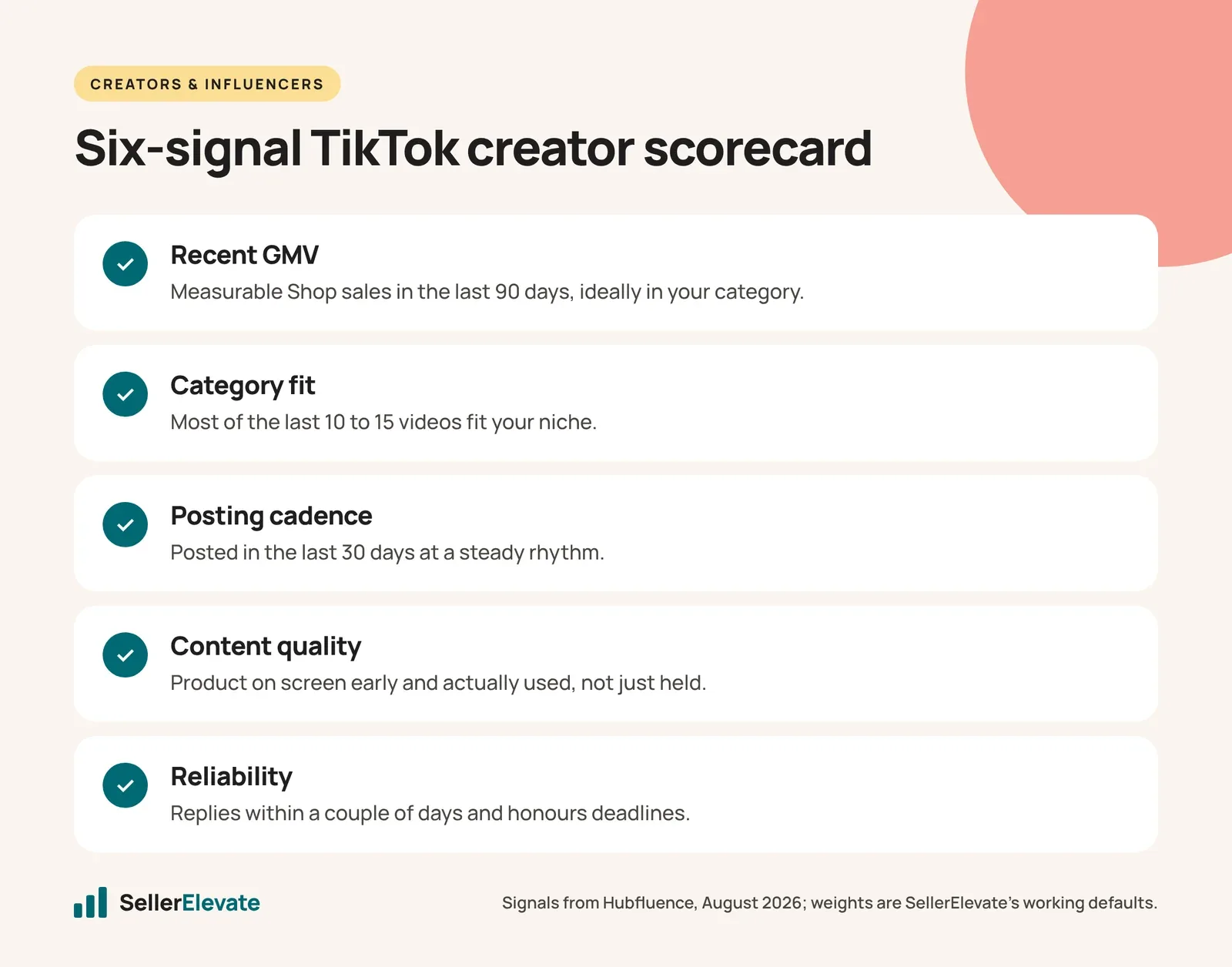
Hubfluence lists six signals: category fit, posting history and cadence, sales and GMV record, audience overlap, content quality and fulfillment reliability. We use the same six and weight them, because they are not equally predictive.
| Signal | What to check | Weight | Pass |
|---|---|---|---|
| Recent GMV | Sales in the last 90 days, ideally in your category | 30 | Measurable GMV from Shop links in the last 90 days |
| Category fit | Share of recent videos in your niche | 20 | Most of the last 10 to 15 videos fit your category |
| Posting cadence | Last post date, posts per week | 15 | Posted in the last 30 days, at a steady rhythm |
| Content quality | Hook speed, product visibility, clear demo | 15 | Product on screen early, used rather than just held |
| Audience overlap | Age, gender, location vs your buyer | 10 | Broadly matches the people who already buy from you |
| Reliability | Response time, past commitments | 10 | Replies within a couple of days, honours deadlines |
Score each from 0 to the weight shown and add them up. Our rough rule: 70 or more, send the sample; 50 to 69, offer commission and ask them to request a sample through the affiliate center so they self-select; under 50, skip.
Hubfluence also flags a hard cut-off we agree with: a creator who has not posted in three months or more is dormant. Do not send them anything until they are active again.
How do you spot a sample farmer?
A sample farmer is someone who requests free products at volume with little intention of posting. They are the main reason unvetted post-back rates sit near 12%. The signs are usually visible in two minutes:
- Many product links, few sales. A showcase full of products from dozens of brands but no visible sales history or engagement on the videos that do exist.
- Category sprawl. Skincare on Monday, car accessories on Tuesday, dog toys on Wednesday. Real affiliates specialize because their audience expects it.
- Gaps then bursts. Weeks of silence followed by a run of low-effort unboxings that show the box, not the product in use.
- Requests that arrive before any conversation. Instant sample requests across your whole catalog, including products far outside their niche.
- Engagement that does not match reach. High view counts with almost no comments, or comments that are generic and repetitive.
- No reply to a simple question. Ask “which of our products fits your audience best and why?” Farmers rarely answer; serious creators usually do.
None of these alone is proof. Two or more together is enough for us to decline.
What is vetting actually worth?
Here is a hypothetical, using clearly labelled numbers. Say a sample costs you $12 in landed product cost plus $6 to ship, so $18 each, and you send 100 samples in a month: $1,800.
- At a 12% post-back rate you get 12 videos, or $150 per video.
- At a 30% post-back rate you get 30 videos, or $60 per video.
Same budget, two and a half times the content. And that understates the gap, because the creators who pass a GMV check are also the ones more likely to sell once they post.
The second reason vetting matters is concentration. When we managed a program of 2,449 TikTok affiliates, the top four videos drove about 57% of video revenue. Most of the value in a creator program comes from a small number of people. Vetting is how you find more of them faster and stop paying to ship product to the rest. Hubfluence makes the same point in plainer terms: a sample is inventory, shipping and team time, so treat it as an investment rather than a gift.
Can you vet at scale?
By hand, Hubfluence puts the practical limit at around 20 to 50 creators. Beyond that you need to filter first (by post rate, niche, audience demographics and 90-day GMV) and only put a human in front of the shortlist.
In practice that looks like this:
- Filter in the affiliate center. Use the creator search filters for category, follower range and GMV band to cut the pool to people who sell in your niche.
- Shortlist 30 to 50. Open each profile and check the last 15 videos and the date of the last post.
- Score them. Use the table above. It takes about three minutes per creator once you have done ten.
- Ask one question. Before approving a sample, message a single question about fit. The reply, or lack of one, is part of the score. Our creator outreach message templates include one.
- Track post-back by creator. Record who posted, how long it took and what each video sold. After two or three months, your own data beats any scorecard.
If you are already stuck with a pile of unposted samples, start with what to do when creators took samples and never posted, then tighten the front end with this scorecard.
What we'd do this week
If you run a TikTok Shop with an active sampling program, here is the order we would work in:
- Pull last month’s sample list. Count samples sent and videos posted. That is your real post-back rate.
- Find the creators who posted and sold. Look at what they have in common: category, size, cadence. That is your profile.
- Pause automatic sample approval on anything but your cheapest SKU until a scorecard is in place.
- Score the pending requests. Approve 70 and above, counter-offer 50 to 69, decline the rest politely.
- Re-invite the proven sellers with a higher commission through a target collaboration, so they are not working off your open rate. We explain the mechanics in target collaboration vs open collaboration.
- Check your own product ratings. Good creators now look at them, because low-rated products drag down their Promotion Performance Score.
Where we would not over-invest: complicated weighting models. The six signals above, applied consistently, get you most of the way. The rest comes from tracking results by creator and doubling down on the ones who deliver.
If you would rather hand the sourcing, vetting and follow-up to a team that does it daily, that is part of our TikTok Shop management work.
Frequently asked questions
What is a good post-back rate for TikTok Shop samples?
Hubfluence puts the typical rate for unvetted creator lists at about 12% and says brands can get past 30% with category fit, a clear brief and follow-up. Measure your own by dividing videos posted by samples sent over a month, then compare it against those two reference points.
Should I send samples to creators with big followings?
Only if they also have recent sales in your category. Follower count reflects past attention, often for content unrelated to selling. A small creator with steady Shop sales in your niche is usually a better bet than a large account that has never converted, and the sample costs you exactly the same either way.
How many creators can I vet by hand?
Hubfluence puts the practical manual limit at about 20 to 50 creators. Above that, filter first in the affiliate center by category, audience and 90-day GMV, then score only the shortlist by hand. Tracking which creators actually post and sell soon gives you better data than any scorecard can.
Does the Promotion Performance Score help with vetting?
Yes, as one signal. TikTok scores eligible creators from 0 to 5, recalculated every 24 hours, and creators at 4.0 and above show a public badge. A badge indicates consistent quality and sound product choices, but still check recent GMV and category fit before you send anything.
Sources
- Hubfluence: How to vet TikTok Shop creators (4 August 2026)
- PPC Land: TikTok Shop’s creator score now gates product reach and badges (June 2026)
- SellerElevate: 2,449 affiliates, four videos made most of the money
Get the honest version of your numbers
A free account audit from the person who would actually run your account.
来源:sellerelevate · sellerelevate.com